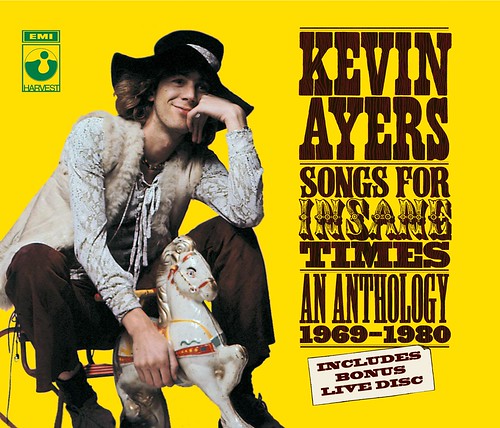
KEVIN AYERS
Songs for Insane Times: An Anthology 1969-1980
(Harvest/EMI)
directors' cut, The Observer Music Monthly, August 10th 2008
by Simon Reynolds
The
greater part --in quantity and quality - of this box set documents a
neglected period in UK rock story: those diffuse years between
psychedelia and glam, a time of drift and discovery during which Kevin
Ayers recorded four albums for EMI's "head" imprint Harvest. Listening
to the selections included on the first two discs of
Songs For Insane Times you can trace an arc from 1967-style carefree innocence to the fundamentally melancholy hedonism of the early Seventies.
The
lighter side of Ayers is not so far from Donovan. He wrote a string of
wistful ditties about faintly aristocratic, "See Emily Play"-style
dreamgirls ("The Lady Rachel", "Eleanor's Cake", "Girl on A Swing")
while the lovely "May I" presents Ayers as a modern-day courtly lover
entranced by a beauty in a cafe, happy just to look but not touch.
"Clarence in Wonderland" offers a LSD-era variation on the classic
"come up and see my etchings" come-on : "Let's go/to my chateau/we can
have a good time/drinking lots of sky wine." Philosophically, lyrics
such as "everything is play" and "everything… is true as long as you
believe it" echo 1968-and-all-that slogans like "take your desires for
reality".
But only a few years on, 1973's "Oh! Wot A
Dream" offered an elegy for the fading utopianism of Ayers's
generation, disguised as a fond tribute to Syd Barrett. In rock
bohemia, collective dreams of change were superseded by an ideal of
"decadence". Which was the title Ayers chose for another paean to a
rock icon friend of his, Nico. It's a loving, painfully empathetic
portrait of an ice queen “suffering from wear and tear,” who keeps
slipping back into “liquid night” despite the out-stretched arms of her
retinue of lovers. Built out of a radiantly rippling wall of
tape-delayed guitar, "Decadence" is one of the most transcendent pieces
of rock of its era. Addressing the same topic but taking the form of a
disturbing self-portrait, "Song From the Bottom of A Well" combines a
jolting noise-scape of guitar-squall with oblique lyrics about the
dangers of self-medication and solipsism: this well is full of wine not
water, with Ayers happy to drown because he sees "all the universe as a
comfortable bath".
Ayers's sound on the first four
Harvest albums was too poppy to be prog but too proggy to really make
it as pop, especially when his band was The Whole World: classical
composer David Bedford on lava-lamp squiggly keyboards, free improviser
Lol Coxhill and his parping and tootling sax, frequently amazing guitar
from a pre-
Tubular Mike Oldfield. The result was marvelously
wonky tunes like "Stop This Train" and "Shooting At The Moon," which
rocked hard but at oblique angles. Later, on, as Ayers worked with more
straightforward backing musicians, the gold to lead ratio declines.
"Caribbean Moon" is typically tropical tripe, its cod calypso horribly
catchy in a "Ob-la-di, Ob-lad-da" style, while the strained whimsy of
"Banana" that kicks off the 1973 live performance on this box's fourth
disc is greeted with a few awkward titters from the Queen Elizabeth Hall
audience.
After his first four albums, Ayers had a
spell at Island (who wanted to make him a star but succeeded only in
making him miserable) then returned to Harvest for three more LPs in the
late Seventies. Titles like
Yes We Have No Mananas and
Rainbow Takeaway
speak eloquently of the inspiration drought of this phase. There's the
odd twilight gem, like the punky "Observations", a jaundiced-eye's
view of a spiritually empty society that's "lost control/to the ones who
sell you dreams to fill that hole". Overall, though, the template of
chansonnier + backing band generates few sparks. Still, even treading
water and going through the jaded-yet-still-debonair motions, Ayers
never lost his charm. Like an English Lou Reed, he's not a good singer,
strictly speaking, but he remains one of the great voices in British
music.
KEVIN AYERS AND ROBERT WYATT
The Grauniad, October 34th, 20?7
by Simon Reynolds
“I
could hardly recognise him at first,” says Kevin Ayers. ”But there,
under that great beard, was Robert and he hadn't changed a bit.” The
singer is recalling his reunion after over thirty years separation, with
Robert Wyatt, his former band mate in The Soft Machine. “As wonderful
as it was odd”, the meeting took place in the summer of 2006 while Ayers
was recording his comeback album,
The Unfairground, his first record since 1992. In odd, wonderful synchrony. it came out last month only weeks before Wyatt’s own
Comicopera.
Intense
friendships always seem like they’ll last forever, but time and the way
of the world wears them away. Suddenly, decades have passed since you
last saw that inseparable soul-mate. Wyatt and Ayers were co-founders of
The Soft Machine, in their heyday second only to Pink Floyd as a
psychedelic trip band at the swirling kaleidoscopic heart of Swinging’
London. But after their debut album and a gruelling tour of America
supporting the Jimi Hendrix Experience, Ayers went off to start a solo
career. Many thought he was set to be a big star, his tousled blonde
mane and debonair charm making him the missing link between Syd Barrett
and Bryan Ferry. “I think Kevin got waylaid by us nutters,” says Wyatt,
meaning The Soft Machine and its anarcho-surrealist mish-mash of jazz
and acid rock. “There was a window there, a moment when Kevin, with his
songs, could have been up there in the charts, as a Donovan type
figure.” Ayers is bemused by this notion that he was diverted from his
true destiny. “Donovan? Good heavens. I am glad that I ended up as Kevin
Ayers! And the people from Soft Machine were a big part of that.”
Wyatt
and Ayers originally met in 1961. “Someone had told Kevin, ‘oh there’s
one other bloke in East Kent with long hair,” says Wyatt. “You’d get
on.” They did. “Robert is an incredibly important figure in my life,”
says Ayers. “He got me started. I liked him and he was doing music so I
wanted to do music too. Robert was extraordinary, full of ideas and
able to talk about art and books. I had never been in that sort of
atmosphere.” Daevid Allen, a wandering Australian beatnik, was lodging
with Robert’s mother--the infinitely tolerant and artistically
supportive Honor Wyatt, a journalist. He befriended the teenagers,
precociously turning them on the hippie values of drugs, sex and free
spirited nomadism. He whisked Ayers off to Balearic bohemian paradise of
Ibiza, where “one could get by with absolutely no money.” Recalls
Ayers, “we hitchhiked down there and lived off fruit from the trees and
fish we would catch.”
Allen, Ayers, and Wyatt formed
The Soft Machine with Mike Ratledge, a keyboard-playing prefect Wyatt
had known at school in Canterbury. One of the great myths of The Soft
Machine is that they were the product of a progressive school favored
by Canterbury’s artists and intellectuals. “Actually, the Simon Langton
School is a totally respectable, conservative grammar school,” says
Wyatt, who remembers struggling academically and getting regular
canings. He left at sixteen with no qualifications, having swallowed a
whole bottle of his father’s multiple sclerosis pills because he was
“terrified of having to go back to school”. Still it is true that the
Soft Machine came from highbrow, arty backgrounds. “Robert was very
lucky to have had parents who were interested in ideas and very open,
you could talk with them about anything and they would listen,” recalls
Ayers, describing the Wyatt household in Lydden as “an absolute
refuge.”. Later, after Wyatt’s father died, his mother bought a small
semi-detached house in West Dulwich and the entire band--plus
girlfriends--lived there. “It was when the group were starting out,”
recalls Wyatt. “I don’t how we all fitted in there. But we did and we
made our racket and my mum was fine about it.” Says Ayers, “There were
plenty of dishes piling up in the sinks and unmade beds. But everyone
was being creative in one way or another, or being intellectual or
questioning and this came out in various forms such as poetry or art,
but most of all music. Soft Machine was the only family I felt I ever
had. We were a group of middle class boys from literate backgrounds,
into jazz and beat writers, and we went off together on this incredible
ride.”
The Soft Machine weren’t the first scions of the
haute bourgeoisie to enter the rock world. But crucially, they were the
first not to conceal their education or their accents. Indeed,
alongside the equally well brought up Syd Barrett, Ayers was the first
English rock vocalist not to sing in an American accent. Wyatt, who sang
as well as drummed, followed suit on the group’s second album. “At
first I was all, “waaugh, bab-eee,” he says, mimicking a standard
American rock voice. But then Wyatt developed his own idiosyncratic
style of falsetto singing, a wondrous blend of frailty and agility,
melancholy and whimsy. “It sounded like me talking, only with notes.”
The
Soft Machine immediately became central figures on the London
psychedelic scene. Yet in many ways their orientation was always jazz
rather than rock. Wyatt even describes himself as a Fifties person who
felt “bemused because the ‘rich flowering of culture’ in the Sixties was
really just the mainstreaming of all these things that had been
underground in the Fifties, like drugs.” Beyond specific ideas to do
with harmony, rhythm and improvisation, what they derived from jazz was
“a kind of recklessness”, a spirit of discovery captured in Miles
Davis’s instruction to his musicians: “play beyond what you know”. This
freeform approach, combined with rock-derived but
unheard-of-in-proper-jazz techniques like distortion and effects, made
The Soft Machine ideal for the sensory overload aesthetic of clubs like
UFO, where they played seemingly every other week in 1966-67.
But
Ayers’s pop sensibility was increasingly at odds with where The Soft
Machine’s music was going, which was long, abstract pieces. ““Kevin had
bravely soldiered on as bass guitarist in what had become really an
instrumental band,” says Wyatt. “He’d accumulated this stash of songs,
but there really wasn’t room for them in the band anymore.” The tour of
America with Hendrix divided the band further: Wyatt enjoyed going on
the piss and the pull with Mitch and Noel of the Experience, Ayers found
the whole rampage of buses, booze and birds a gruelling affront to his
sensibilities. The group split up on its return. When they reformed,
they invited Hugh Hopper, another alumnus of Simon Langton, to be the
bass player. Wyatt enjoyed drumming in a wild, freeform style
unsuitable for backing pop songs and happily went along with the
jazz-rock direction. But after three more albums, he too was squeezed
out as the Soft Machine became an increasingly uptight fusion outfit
with little room for playfulness.
 RW and SR at Hay Literary Festival, 2007 (pic by Richard King)
As
important as The Soft Machine was to their development, few would
disagree that Wyatt and Ayers came into their own as solo artists.
Initially, Wyatt formed his own Softs in the form of Matching Mole, but
after a drunken tumble from a high window left him paralysed below the
waist, he had to give up drumming and the gang mindset of the performing
band, and reinvent himself as a studio-bound artist. Started before the
accident but finished and informed by that shattering trauma, 1973’s
Rock Bottom is
Wyatt’s masterpiece. From “Sea Song” (an oblique portrait of his new
love and lifelong partner-to-be Alfreda Benge, a.k.a Alfie ) to “Little
Red Riding Hood Hit the Road” (which exorcised his post-paralysis
anguish via bathos-laden turns of phrase like “oh dearie me”), the album
combines experimentation, emotion and melody with an exquisite
delicacy.
Meanwhile, starting with 1969’s
Joy of A Toy,
Ayers launched an equally enthralling career, his output ranging from
light-hearted ditties like “Clarence In Wonderland” to nihilistic
noise-scapes like “Song from the Bottom of A Well”. Another highpoint
was “Decadence”, a rippling, rhapsodic paean to his friend and
fellow-traveler in hedonism, Nico, an ice queen “suffering from wear and
tear” who perpetually slips back into “liquid night” despite the
out-stretched arms of her lovers. “I never kiss and tell,” he says
tartly when asked if he and Nico were ever involved.
Ayers
and Wyatt belonged to a milieu of English mavericks who recorded for
“progressive” labels like Harvest, Island, Charisma, and Virgin. Sharing
a similar sensibility of gentle humour and genteel experimentalism,
this was an incestuous scene, the musicians frequently collaborating or
guesting on each other’s albums. The labels, similarly, exuded a
longhaired, we’re-only-playing-at-being-a-record-company vibe. Virgin
seemed more like an arts council for weirdos than the Industry. “It
wasn’t really that idealistic,” says Wyatt. It’s just that “the Railway
Enthusiast”--his nickname for Branson--“had noticed there was a market
for bands who could sell albums without hit singles, based around the
college gig circuit.” Ironically, Virgin would later maneuver Wyatt into
recording a single--a cover of the Monkees’ “I’m A Believer”--which
actually did become a hit and got the wheelchair-bound singer onto Top
of the Pops.
Ayers, who’d left the laidback Harvest,
was facing similar pressures. His new label Island were convinced they
could turn him into a big star. “It really messed me up and I lost
complete confidence in what I was doing.” It was the start of an unhappy
period of desultory recordings and feeling disconnected from the music
scene, with Ayers alternating between his houseboat in Maida Vale and
long sojourns abroad.
When punk arrived, the
progressive scene was deemed the domain of “boring old farts”. The new
dogma declared that rock had been enfeebled by its attempts at maturity
and sophistication. It was time for a rejuvenating jolt of teenage
proletarian energy. The Fall’s Mark E. Smith singled out the Canterbury
Scene--The Soft Machine and all the welter of bands and solo artists it
spawned--when he declared “rock was ruined when the students took it
over”. Wyatt sympathizes with this attitude, which with typical
kindliness he interprets as “a sincere attempt to reassert that rock
music was a music whose vitality came from the bottom up in terms of
social power structures”. Still, there was a moment there in 1976-77
when the mellow meandering of a whole generation of artists--everyone
from Brian Eno to John Martyn--was deemed irrelevant.
A
few years later, the middle class cadres within punk stopped worrying
so much about maintaining their fake-prole accents and hiding their
Hatfield and the North albums. Punk turned into postpunk and the
students took over again (had they ever really been dislodged?). Many of
the new bands looked back to the music they’d been listening to before
The Ramones and “Anarchy in the UK”. These groups, such as Scritti
Politti (whose vocalist Green was hugely indebted to Wyatt’s “English
soul”), wanted to move beyond straightahead punk, beyond rock itself,
and the Canterbury Sound was a suggestive example of a concerted attempt
to un-rock rock. Wyatt was coaxed back into recording by Geoff Travis,
the boss of Rough Trade (home to Scritti). “Virgin were cross and said I
couldn’t do albums for another label, so we decided to do a series of
singles, cover versions.”
During his period of
disengagement from music, Wyatt had become politically engaged: he
started tuning into foreign radio stations, including Radio Moscow, and
reading the
Morning Star. Eventually he joined the Communist
Party because its internationalism fit his own “xenophilia”. He
explains, “if anybody starts to build up a heat against Johnny
Foreigner, sort that chap out, my instincts are to take sides with
Johnny Foreigner. They used to call it being a traitor but actually I’m
just a xenophile.” The Rough Trade singles included versions of Latin
American revolutionary songs, a pro-Stalin ditty from 1940s America, a
tune called “Trade Union” by a Bengali group based in Brick Lane, and
most famously, Elvis Costello and Clive Langer’s anti-Falklands War
ballad “Shipbuilding”.
Ayers is a xenophile if anybody
is. He spent his early childhood in Malaysia, “running around a beach
and completely lost in my own world “. When his family returned to Herne
Bay, the twin culture shock of England’s grey-skied, grey-faced
repression and being plunged into boarding school aged 12 was a massive
trauma. Ironically, for an artist who is regarded as quintessentially
English, Ayers has spent most of his life since that “homecoming” trying
to escape England, traveling all over the world and eventually settling
in France. “Sunnier climes have always been more compatible to
me--people there are so much more relaxed and have time for the good
things in life like good food and wine.”
* * *
In
1992 Ayers declared, “Between the ages of 17 and 40 I had a great time,
no grounds for complaint whatsoever. My problem is just that I don't
know what to do with the rest of my life." For both of the ex-Softs,
the Eighties and Nineties were…. variable. Wyatt alternated between
sporadic recording and periods of depression, partly induced by “the
political weather… you can get a very cold draught sometimes.” Both
artists have had struggles with alcohol, culminating this year with
Wyatt going sober and quitting the potions he’d always seen as essential
to loosening his creativity.
Comicopera’s first “act” partly
concerns the deleterious effects of his drinking on his relationship
with Alfie (who wrote a lot of lyrics on the album), a syndrome she has
described as “bereavement within a marriage.”
Both
Comicopera and
The Unfairground
deal with aging, that sense of twilight memorably captured by Dylan a
few years ago with the lines “it’s not dark yet/but it’s getting there.”
Serenity and wisdom have eluded both artists. In one song, Wyatt
sings, at once wry and deadly earnest, of envying Christians and Moslems
for their certainty, their confidence that God has got their back.
After the first act dealing with personal relationships, and a second
moving out into the real world of politics and war, the final section
sees Wyatt casting around for “solutions” via a series of cover versions
that touch on spirituality, revolution, surrealism, and free
improvisation.
The Unfairground, meanwhile, exudes a worldweary
confusion distilled in the line “I don’t understand anything as I grow
older/Nothing seems to be any clearer”.
“When you get
to a certain age the inevitable crumbling becomes very real,” Ayers
admits. “It’s how you deal with that is the challenge. Robert said to me
a very long time ago that I was the sort of person who would end up an
old man on a park bench feeding ducks and wondering why people weren't
nicer to each other!” Yet for all its bleakness,
The Unfairground sounds sprightly and springheeled: falling in love was a major catalyst for Ayers even making a record again. And
Comicopera’s
sheer delight in strange and marvellous combinations of sounds is a
tonic. In the end, there aren’t answers but there are consolations, the
highest (and healthiest) being music and friendship. Both
The Unfairground and
Comicopera
involved a company of musician pals: Ayers called on 26talents, among
them folk singer Bridget St. John and Hugh Hopper, while Wyatt’s
“imaginary gang” contained such seeming incompatibles as Brian Eno and
Paul Weller. “I say imaginary cos they were never in the same room at
the same time,” he chuckles. “I do believe in doing that, but I’ve found
that often grumpiness ensues.”
Parts of
The Unfairground were recorded at the same studio, owned by Roxy Music guitarist Phil Manzanera, where Wyatt recorded
Comicopera.
Hence the reunion last summer. “It was really great to see him again,”
says Wyatt. “He’s gone through a lot of problems, battling the demons.
And he’s looking battered, but he’s survived. And it was nice because I
had the opportunity to say ‘Look, Kevin thanks very much for your tunes
at the beginning’. Without his natural ability to write proper songs,
The Soft Machine would have been hard pressed to cobble together much
convincing original material of our own.”
Wyatt
actually appears briefly on his old friend’s record, albeit as a
disembodied vocal texture, sampled and listed in the credits as The
Wyattron. “It’s not Robert, but it is a memory of Robert,” says Ayers.
“And that makes a lot of sense to me, as that is what I have.”

SR and RW at Hay Literary Festival, 2007 (pic by Richard King)