Saturday, December 19, 2020

15 Songs of Christmas

 12 songs for Christmas 

Stanford Live - Stanford Arts

November 2017

{plus 3 bonus xmas chunes at the end}


^^^^^^A 'Fairytale of New York'-Free Zone^^^^^^


John Lennon and Yoko Ono / Plastic Ono Band, “Happy Xmas (War Is Over),”  1971

Hard to believe that the man capable of the acrid disillusion of “Working Class Hero,” “God”, and “My Mummy’s Dead” could just one year later record this soppy sway-a-long.  Wonderfully incongruous, also, to hear Yoko “The Scream” Ono juxtaposed with a children’s choir. But this was not Lennon’s first attempt at a Christmas Number One. There was also “Cold Turkey”, about eating left-overs on the 26th   - what Brits call Boxing Day.

Slade, “Merry Xmas Everybody”, 1973

Fronted by the Lennon-as-foghorn blast of Noddy Holder, Slade were Britain’s biggest hit-makers during the glam early Seventies. But out of their half-dozen Number Ones it’s  “Merry Xmas Everybody” that has endured as a hardy perennial, reappearing in the UK charts another 22 times around Yuletide. Its blend of stomp and sentimentality captures those woozy-boozy festive feelings. From Holder’s mirrored top hat to guitarist Dave Hill’s silver suits, the band actually looked like Christmas tree ornaments.


Wizzard, “I Wish It Could Be Christmas Everyday,” 1973

Another glam-era chart topper, Wizzard’s Roy Wood was a pasticheur with an uncanny facility for replicating the signature sound of admired predecessors.  Not for the first time, the target of Wood’s sincere flattery here is Phil Spector. This time the Wall of Sound is decked with tinsel and the tinkle of sleigh bells. Slade’s 1973 offering was the bigger smash, but “I Wish It Could Be Christmas Everyday” was close behind, reaching #6 and making seasonal re-entries on another dozen occasions . 


Paul McCartney, “Wonderful Christmas Time”, 1979

This ought to be too ingratiatingly sickly to stomach, but Macca’s deft craftsmanship and clever touches (synth squiggles like bubblebath, that burbling reverb-shimmered bass) make this charming not cloying.


The Stranglers, “Don’t Bring Harry,” 1979

Punk-era misanthropes the Stranglers released this morosely languid ditty about heroin – personified as the creepy and insidious “Harry” – as a Christmas single in 1979. Amazingly they would have a huge winter hit a couple of years later with another song about smack, the gorgeously bittersweet and implicitly hymnal “Golden Brown”.


The Greedies, “A Merry Jingle”

Full name The Greedy Bastards, this supergroup of Brit rock scene liggers consisted of most of Thin Lizzy plus ex-Pistols Paul Cook and Steve Jones. What most likely started as a beery jape conceived in a Soho pub – “let’s give a brace of Yuletide standards a lumpen sub-punk do-over, shall we lads?” -  became a minor UK hit.


Cristina, “Things Fall Apart”, 1981

Fresh from her disco-noir remake of Peggy Lee’s “Is That All There Is?” – with altered lyrics so decadent that Leiber & Stoller had the cover version suppressed –  Cristina’s contribution to ZE Records’s Christmas Album was a nihilist subversion of the seasonal song, festering not festive.    


The Waitresses, “Christmas Wrapping”, 1982

Best known for “I Know What Boys Like”, these Akron New Wavers also scored with this wonderfully tart tale about being too busy and too jaded to celebrate the holidays, but then drops the cynical front for the sweetest of unexpected happy endings.


The Pretenders, “2000 Miles”, 1983

Another Akron New Waver, Chrissie Hynde is one of rock’s true originals as a vocalist, with her magnetic alloy of tender and tough, needy and nasty. But here the edge of Pretenders classics like “Brass In Pocket” and “Talk of the Town” softens and Hynde allows herself a completely moist moment of Christmassy wistfulness.


Frankie Goes To Hollywood, “The Power of Love”, 1984

Frankie dominated 1984 with a triptych of singles with Epic Themes. “Relax” was about sex, transgression, and shock (it was banned by the BBC); “Two Tribes” grappled with War, Armageddon and US vs USSR geopolitics; the ballad “Power of Love” hymned the redemptive power of devotion and faith. All three reached the top of the UK charts, but “Power” failed to be the Christmas Number One as intended, despite its lavish Nativity- themed video and overblown orchestral arrangement.


X Project, “Walking in the Air,” 1993

This rambunctious bass-booming rave anthem is a Christmas song only by association, sampling Welsh choirboy Aled Jones’s hit single “Walking in the Air” - a song originally written for the animated film of Raymond Briggs’s children’s book The Snowman, in which Santa Claus makes an appearance.  Not content with simply expropriating Jones’s angelic vocal, X Project sullies his cherubic aura too by turning the innocuous lyric into drug imagery: “We’re walking in the air / while people down below are sleeping as we fly” becomes a metaphor for the all-night rave’s collective Ecstasy high.


Killer Mike, “Christmas Grind”, 2003

Off the album Crunk and Disorderly, “Christmas Grind” belongs to a surprisingly sizeable sub-genre of holidays-themed rap songs: Kurtis Blow’s “Christmas Rappin”, Treacherous Three’s “Santa’s Rap”, Run DMC’s “Christmas in Hollis”, Ludacris’s “Ludacrismas”, Master P’s “Christmas in Da Ghetto”,  Ying Yang Twins “Ho Ho”, Run the Jewels’s “A Christmas F*cking Miracle”. (Oddly there’s no “Have Yourself a Gangsta Gangsta Kwanzaa” out there).  Kicking off with a shotgun blast, Killer Mike’s seasonal offering does not exactly comprise tidings of comfort and joy: the chorus goes “it’s Christmas time/I’m on the grind/Gonna take what’s yours and make it mine.”


BONUS XMAS TUNES


Monday, November 16, 2020

robert wyatt and friends

Robert Wyatt & Friends
Theatre Royal Drury Lane 8th September 1974
Observer Music Monthly, November 20th 2005

by Simon Reynolds


Long bootlegged, this glorious live album documents an intriguing moment in UK rock history, when the rock mainstream and the outer-limits vanguard were in bed together.  Three decades on, it’s hard to imagine a contemporary equivalent to the supergroup that Wyatt convened in September 1974: multiplatinum-selling musos Mike Oldfield and Pink Floyd’s Nick Mason rubbed shoulders with out-jazz players Julie Tippetts  and Mongezi Feza, and with avant-proggers such as Henry Cow’s Fred Frith, Hatfield and the North’s Dave Stewart, and Soft Machine alumnus Hugh Hopper. There’s also a cameo appearance from Ivor Cutler,  John Peel’s favorite comic eccentric. Peelie himself features as the show’s compere, informing the long-haired, afghan-wearing audience that the musicians will be uncharacteristically sober tonight, because the door to the Theatre Royal bar has been locked for fire-and-safety reasons.  

The wondrously woozy music played that evening must have been intoxication enough, surely, for performer and listener alike. After the Dada-esque sound-daubings of “Dedicated To You But You Weren’t Listening”, the bulk of the set consists of a run-through of Rock Bottom, the Wyatt album released earlier that summer, a crushingly poignant masterpiece shadowed by the singer’s paralysis following his fourth-floor tumble during a wild party. “Sea Song”,  as mysterious and beautiful an oceanic love ballad as Tim Buckley’s “Song To the Siren,” opens up into a fabulous extended improvisation, a malevolent meander of fuzz-bass and glittering keyboards that’s something like an Anglicized Bitches Brew. Wyatt’s falsetto spirals up into ecstastic scat arabesques, as though his spirit is trying to escape his shattered body.  “Little Red Riding Hood Hit The Road” --its title a whimsy-cloaked allusion to the accident--is equally stunning. Feza’s trumpet again channels Miles, while Wyatt’s delirium of anguish is only slightly softened by the English bathos of lines like “oh dearie me, what in heaven’s name..”  The singer actually miauows at the start of “Alifib,” a gorgeous quilt of shimmering keys and glistening guitar (courtesy of Oldfield, then regularly voted the top instrumentalist in the UK by music paper readers). The feline thread is picked up with “Instant Pussy,” originally recorded by Wyatt’s short-lived band Matching Mole and featuring yet more gorgeous abstract vocalese from the wheelchair-bound bound singer. “Calyx”, a different sort of love song, features killer lines like “close inspection reveals you’re in perfect nick”, and the set ends with a rampant, edge-of-chaos take on  “I’m A Believer,” the Monkees cover that took Wyatt into the UK hit parade. 

Alarming but true: the best record released in 2005 is a time capsule from 31 years ago.
                                                                                                

Monday, September 21, 2020

RIP Simeon Coxe of Silver Apples

 SILVER APPLES 

Silver Apples 
Melody Maker, 1995? 1994?

by Simon Reynolds 

   Pipping Kraftwerk to the post, paving the way for Suicide, Silver Apples were the first rock band to use synthesisers as their art's core, as opposed to mere ornamentation.  They were a duo, percussionist/vocalist Danny Taylor and a chap called Simeon who identified so strongly with his self-cobbled instrument (a bunch of audio-oscillators with 86 manual controls) that he called it The Simeon. He also sang and strummed the banjo a bit.  After two decades of being legendary but little heard, the band's two virtually unfindable LP's, 1968's 'Silver Apples' and 1969's 'Contact' have been compacted onto a single silver disc.     


Hooray for that, and about fucking time.  For this is astounding stuff, a manic, mantric, mesmerising head-rush that's the missing link between the acid-rock of 13th Floor Elevators and the aciiiied tekno of RichieHawtin/FUSE/Plastikman. When Taylor and Simeon start yowling about "oscillations, oscillations, electronic evocations...spinning magnetic fluctuations" in their highly-strung quaver, they're clearly singing from the same acid-scorched mind-zone as Roky Erikson, i.e. the 'white light' stage of sub-atomic consciousness that's the ultimate level of the LSD experience.  But musically, these late Sixties tracks contain in germ form the oscillator-riffs, pulse-sequences and frequency-arpeggios that make up the lexicon of techno today.    

The sense of prophecy is uncanny. "Velvet Cave" could be '92-style 'ardkore, layering Joey Beltram sine-wave synth over fitful fatback funk.  "Program" even features 'sampling', in the form of bursts of radio broadcast--adverts, classical fanfares, shortwave Italian, and so on. Hell, with the banjo-driven "Ruby" and "Confusion" they even got to the hillybilly/techno hybrid 25 years ahead of The Grid!    Only the occasional dippy song-title ("Sea Green Serenades", "Lovefingers", "Whirly-Bird") and the Grace Slick-like balefulness of the vocals on the wonderfully accusatory "A Pox On You",  hint that these guys are hippies. How they ever managed to get so far ahead of their own time, we'll probably never know, but this record is no historical curio--it's mindblowing in an eerily contemporary way.     


^^^^^^^^^^^^^^^^^^

Check out these pieces by Lee Shook 


- a memorial tribute to Coxe 

- based around this vintage article by Simeon Coxe, a "biography" of the Simeon synthesizer published in Other Scenes magazine 1969,  with some photos of Coxe playing the machine onstage 


Thursday, August 20, 2020

Brian Eno / King Crimson box sets (1989)

RETRO-ACTIVE: BRIAN ENO + KING CRIMSON BOX SETS
Melody Maker, 1989

by Simon Reynolds

"What I've always liked in music is the sense of being
baffled... When you think: 'God! I like this, but I don't
know why!'" For a practising musician, Brian Eno has an
unusually penetrating insight into music. Eno is almost
unique in that by far the best explications of his methods,
aims and achievements, issue from his own mouth.  But then
Eno was one of the first pop musicians who was as much a
critic as a creator.  With Roxy Music, Eno more or less
presided over the birth of meta-rock: music that (self-)
consciously refers to other music.  In a way, this CD box set
tells the story of Eno's growing disenchantment with the
knowingness and referentiality of his early music, and his
quest for a way out of post-modernism's "mire of options"
into a music of forgetfulness and self-elimination.

 According to Eno, "the biological function of art is to
expose you to disorientation... Art rehearses you for
uncertainty". Roxy's early music was originally forged in
this spirit.  But success placed them in a position "where
that uncertainty had to go", as did their "insanity...  that
element of clumsiness and grotesqueness".  Eno left in order
to lose himself again in unmapped territory.  He hit upon "a
whole series of tricks and subterfuges that I use to create
an accidental situation..." His aim was "to defeat bits of
me, or amplify bits of me...  I'm looking to reduce my
conscious intervention and get the intuitive parts of me
going". Eno's strategies included chance (the use of a pack
of card with musical ideas written on the back) and
contingency (found sound, tape delay techniques etc).

Another Green World (1975) originates from a strange
period in rock history when Eno could call on the talents of
both John Cale and Phil Collins without it seeming
incongruous. What Another Green World reminds me most of is
The Residents' "Commercial Album". It's a collection of
musical sketches: sometimes exquisite watercolours, sometimes
lamentably Python-esque skits. Both "In Dark Trees" and
"Zawinul/Lava" anticipate the stark, Satie-esque simplicity
of the instrumental half of David Sylvian's "Gone To Earth":
the former, a mind's eye vista of paddy fields and aquaducts,
the latter, a rainforest's dawn chorus.

But for each of these succint, spare studies, there's a terribly dated item of
English eccentricity, with the Eno persona pitched somewhere
between Cat Stevens and Bill Nelson. "I'll Come Running" is
Gilbert O' Sullivan on LSD, all plinky plonky piano and cod-
surrealist couplets. Elsewhere on the album, "The Big Ship"
is a prototype for the second side of  Low; "Sombre
Reptiles" sounds like dying rock dinosaurs languishing in
their own equivalent of the elephant's graveyard, while the
title track you'll already know and love as that most restful
theme tune for BBC2's Arena.

Before And After Science (1977) was one of Eno's most
feted albums, and one of the ones he personally rated least.
Listening now, one can only agree with his verdict. It's a
curiously muted, indistinct record; an oddly centre-less
music, teeming with beautiful detail (guitar filigrees as
graceful as Japanese calligraphy, mysterious sounds
shimmering in the furthest corners of the mix), but unhappily
placed midway between dispersal and focus.  The subdued warp-
funk of "No One Receiving" looks forward to Fear Of Music
and Remain In Light. "Backwater" is uptempo, quirked-out
pop, riddled with twee rhymes like "a Senator from Ecuador
who talked about a meteor... passed it on to a conquistador".

As with Another Green World, every so often there's a
pretty sound-painting like "Energy Fools The Magician", but
in the main tracks like "King's Lead Hat" fall within the
manageable orbit of Anglo eccentricity. (At the time Eno was
fond of patronising forgettable curios like the Portsmouth
Sinfonetta). Only later was Eno to go out-of-orbit, into
truly dis-orientating territory.

 So funnily enough, by far the most absorbing and simply
beautiful music in this box set is Apollo, a collection of
"atmospheres and soundtracks" for Al Reinhert's film of the
moon landings - an album disregarded in its day (1983) as
just another in Eno's ambient series. With his forays into
ambience, Eno went from meta-rock (which relies on the
listener being thoroughly schooled in rock history, in order
to understand the mischievous mis-appropriation of that
history) to infra-rock.  The impressionism of the early solo
albums gives way to a total atomisation of sound.  Eno
compared ambience with Monet's "Waterlilies": huge canvases
but without "any predominant features... your eye focusses on
no landmark, the whole thing is a continuous rippling
surface.  Close up, the intricacy is amazing. You have to
wander through them. I can gaze at them for hours and never
get bored".

Eno's ideas about ambient music have an affinity
with that currently fashionable area in modern science called
"chaos theory", which focuses on phenomena that are
structured but impossible to predict (cloud patterns, the
crystalline structure of snowflakes, the movements of
fluids), and whose infinite variability is captivating.
Ambient music's paradoxes (it's both serene and chaotic,
intimate and impersonal, sedative and utterly absorbing)
satisfied the demand Eno had always made of pop: blissful
bafflement.

Apollo attempts to supplant the official version of
space travel (another giant step in man's mastery of the
cosmos) and rewrite it as an experience of estrangement,
humility and awe. The sound of "Apollo" consists of twinkling
clusters, remote susurrations and rumblings, an infinite
recession of motes into the backwaters of the galaxy. Lovely.

Another of EG's 20th Birthday box sets comes from
KING CRIMSON, the band captained by sometime Eno collaborator
and guitar virtuoso Robert Fripp. This stuff has dated very
badly indeed. The multi-million selling In the Court Of The
Crimson King (1969) is a baroque'n'roll calamity. "21st
Century Schizoid Man" is a typical Crimson frightmare, all
scrofulous, overwraught improvisation and brash, blaring
saxophone.  "I Talk To The Wind" is an almost fetching piece
of pastoral psychedelia, marred by a flute (never a good
idea). And "Epitaph" inhabits much the same plush boudoir of
mock-despair as "Nights In White Satin". Larks' Tongues In
Aspic (1973) is more bearable, the title track leapfrogging
between Oriental reveries and art school Sabbath heaviosity.

Discipline (1981), with execrable vocalist Peter Sinfield
long since banished in favour of Adrian Belew, is almost
listenable. "Elephant Talk", for instance, is a prog rock
version of Tom Tom Club's "Wordy Rapppinghood", with its
corrugaged mutant funk riffs and lyrical romp through Roget:
"ballyhoo and balderdash ...  diatribe and dissension".  It
doesn't sound nearly as redundant now as it must have done in
'81.


2020 note: Well, it's interesting how taste can shift around over time... Another Green World is now one of my all time favorite albums (and in the Eno-alone chart would be in a tight cluster at the top with On Land, My Life in the Bush of Ghosts, Plateaux of Mirrors) and  Before and After Science I like a lot more (especially the washed-out / washed-up songs about castaways at the end of time type tunes). Apollo, conversely, I find "nice", but never play.

King Crimson, also, I've come to appreciate if not quite adore.


Thursday, July 23, 2020

futuredada

Various Artists
Futurism & Dada Reviewed
(LTM)
emusic

by Simon Reynolds

This compilation is a time capsule from early Twentieth Century Europe, when the continent swarmed with -isms: not just famous ones such as Cubism and Constructivism, but nutty lesser-knowns like the Nunists and Rayonists too. Although they differed on the precise details, these manifesto-brandishing movements typically called for an utter overhaul of established ideas of art, arguing that Western Civilisation, enervated and sagging into decadence, needed an invigorating injection of barbarian iconoclasm to renew itself. The material from the Italian Futurists on this anthology overlaps somewhat with LTM’s Musica Futurista collection, but includes a much longer version of “Risveglio di una Citta,” a symphony of scrapes and whirs woven by Luigi Russolo, the movement’s chief musical theoretician and coiner of the enduring buzz-concept “the art of noises.” His brother Antonio’s “Chorale” sounds like a conventional classical overture, except there’s this roar of turbulence that intermittently rears up, as though’s there’s a gale raging outside the concert hall. Wyndham Lewis, British futurist sympathizer and leader of his very own -ism Vorticism, recites a poem that once probably seemed audaciously “free” with its run-on stanzas, but now positively creaks with starchy quaintness. The Dadaist material, however, retains a good portion of its originally scandalous shock of the new. On the noise-poem “L’Amiral Cherche Une Maison A Louer”, Tristan Tzara, Marcel Janco and Richard Huelsenbeck unleash a polyphonic babble of multilingual nonsense, punctuated with circus-clown irruptions of  rude noise, enough to get your blood boiling with excitement almost a century later. Huelsenbeck also contributes a great reminiscence of the genesis of Dada, incongruously backed with a Indian raga drone. Kurt Schwitters’ life-long work-in-process “Die Sonate in Urlauten”, captured for posterity in 1938, is a tour de force of phonetic poetry, peppering your ears with flurries of phonemes and scattering consonants like confetti around your head. It’s oddly reassuring that works by the Socialist-leaning Dadaists have aged far better than the efforts of the Futurists, Mussolini fans almost to a man.
                                                                                   

Various Artists
Musica Futurista: The Art of Noises
Salon/LTM
emusic

by Simon Reynolds

As their name suggests, the Italian Futurists worshipped technology and urban life, while stridently despising the romanticisation of the pastoral and the pre-industrial past. They proposed a stringent program of modernism that would radically reinvent everything from from painting to politics to pasta (which their leader Filippo Tommaso Marinetti proposed replacing with an entrée of perfumed sand!). Music was not left unscathed. To put into practice his theories about a new form of composition called “the art of noises” that would abandon tonality and the traditional orchestral palette of timbres, Luigi Russolo invented brand-new instruments, the famous Intonarumori (which roughly translates as “noise-intoning machines”).  On Musica Futurista, the most exciting tracks are test-tone showcases for Russolo contraptions like the Gorgogliatore (“gurgler”), which generates a sproing-ing metallic rustle, and the Ululatore, which supposedly translates as “hooter” but sounds more like a peevish vacuum cleaner with a piece of sandpaper stuck in its craw.  When the Futurists relied on conventional instruments, their efforts suffered from being, well, not futuristic enough, such that you can you can see why Russolo went to the bother of building the Intonarumori. On Musica Futurista, there’s rather too much clunky piano bombast, heavy on left-hand basso profundo chordings, from figures like Francesco Balilla Pratella, who supplies a series of etudes entitled “La Guerra”. Apart from the Intonarumori offerings, the best tracks come from the non-musician Marinetti. His prose poem “La Battaglia Di Adrianopoli” uses onomatopoeia to recreate the siege cannons and machine guns of the Balkan Wars, and like “La Guerra” showcases the Futurists’ highly suspect exaltation of modern mechanised warfare. Also relying solely on that most ancient instrument, the human voice, his “Parole in Liberta” offers more abstract sound-poetry, although if you don’t understand Italian most of the liberties Marinetti takes with sense and syntax will necessarily be lost on you. Composed in the 1930s and constructed out of found sounds (water  splashes, motor cars,  weeping babies, birdsong, etc) and protracted stretches of near-silence, the 13 minute “Cinque Sintesi Radiofoniche” anticipates and preempts the post-WW2 musique concrete of  Pierres Schaeffer and Henry.  Bravo, F.T., bravo: this time at least, you reached the future way ahead of the pack.
                                                                                   

Sunday, June 28, 2020

thinking about music

A dialogue between me and Ezequiel Fanego of Caja Negra  (my publisher in Argentina) for the Chilean music webzine Grieta Mag, on the subject of  the role of writing about music.  (Spanish language version here.). 

Grieta editor Laura Estévez kicks things off with the initial question:   

How to think music? 

Simon Reynolds: 

The first thought I had in response to this question is another question: do we need public thinking about music?  What function does it serve? Especially at the present moment, but generally as well – it would seem to be an inessential activity. I have long thought the relief of human suffering, whether physical or mental, is the highest calling, and that belief has a new sharpness in the current crisis. Writing about music would seem to occupy a fairly low status on the hierarchy of human needs.

Then again, you might say that the inessentials are what actually gives life flavor and elevates it beyond the grind of everyday survival and getting by.  These things are luxuries, but ones we feel we can’t live without. 

But even then, many  people – perhaps most people on the planet – enjoy music in a fairly thoughtless way. And are no worse off for it, at least in terms of enjoyment. Patterned sound provides an unreflective pleasure that might affect them intensely, but it doesn’t necessarily have anything to do with a larger significance – it’s on the same plane perhaps as food, or sports, or clothes, which are all things that people feel passionate about.  But they don’t look for criticism or theory to make sense of it. What are they missing? Is there a surplus value that can be created through public thinking about music that deepens the experience of it, or helps to sustain a community around the music -  a community of disagreement as much as consensus?

The second thought I had stirred by this question is to do with how much of the pleasure of music –  what makes a piece of music “good” or what makes it work – actually bypasses thought.  The challenge for me as a critic from very early on was to do with wanting to register in prose all these thoughtless elements – the insistence of rhythm,  the sensuality of sound, in a sense the violence of music as it floods your body. These elements are where the power of music largely lies, as opposed to the cultures around music or the expressed intent of the artists. But they’re very hard to verbalise, and accordingly, have largely been written around, in a circuitous dance of avoidance, by music critics. 

This aspiration comes across in my writing more for a native English speaker, where the prosody of the language, the kind of tricks I use (“cheap tricks” like alliteration, subtler ones like assonance, rhythmic effects and cadence) are things I do instinctively and viscerally – and likewise affect English speakers in a largely unconscious way. Some of that necessarily gets lost in translation, as it’s do with the musical properties of the English language; if you reading the original text as a second language, you can’t access the playfulness or “dance of words’ that is going on.  But this kind of instinctively deployed word-magic, this musication of language itself – this is actually me “thinking music” – allowing the music into my thought, rather than describing it from a distance.

What about scholarly music critics who know about keys and structures? Technical musical language can describe these intensities in a very narrow sense, like a diagram of an electrical circuit, but it doesn’t  convey what an electric shock feels like.  When critics use that kind of specialist terminology,  the main effect for the layperson reader is an aura of authority: you feel “this person knows what they’re talking about”, and that might give you confidence in their pronouncements. But you don’t understand what they’re offering as “proofs”. Indeed a synesthetic metaphor or a ripe piece of imagery that someone like me might come up with is probably more effective as a way of conveying to listeners – who like me don’t know the technical terms -  what they might experience when they listen to the music.

I am interested in the huge gulf between how musicians think about music and how critics and fans who lack musical training think about it.  At least 90 percent of what the musician is concerned with is what I call “nonsignifying craft” – how to structure a piece of music in terms of intros, outros, bridges,  key changes; how to technically achieve certain sounds; how to construct feel or groove. Composition, arrangement, engineering, production – this effort results in about 90 percent of our pleasure and sensation in music. We are caught up in the way tension builds and releases, the surprising twists,  the juxtaposition of textures across a vertical organization of sound. And yet it’s something that’s very hard to write about in anything but the vaguest terms when it comes to a specific song or track.  Critics tend to approach music as if is primarily about communication – the transmission of a lyrical statement, or of an emotional state. But much of the pleasure and excitement of listening to music is about structure – the structuring of an emotion, a construction that moves through time and is built in four dimensions rather than just three.  And it’s about sensations.  Again, it’s very hard to think this stuff and put it into words. But it’s the pressure of those sensations and movements against the mind that produces the most interesting thinking about music for me.

My final thought on “thinking music” is that it’s not something you can be prescriptive about. As a writer, you are trying to get people to think the way you do about something.  But as a reader, what I am looking for is thoughts I could never have had myself. So often the most excitingly disorienting thing is when I encounter a new writer whose mind moves in a completely different way. I think, “how on Earth did you think of that?. Where do those images – that particular sensual response to sound – spring from?” To the extent, that I’ve managed to get people to think the way I do about music and use a similar kind of language in their writing  – it’s self-defeating.  You don’t want to read something and think “I could have thought that”. You want to be startled by completely alien perceptions.


Ezequiel Fanego:

 First, I would say that as publishers we were always interested not precisely in thinking music but thinking through music. Music can be a life changing experience: a record or a song can change the way you feel about politics, friendship, your own life, etc. And not only through the lyrics but also through the perceptual world that it triggered. So we like when the writing doesn’t impose it´s own concepts to the music, but when it´s rather affected by it, and express how it was enriched or impoverished by the aural experience. Music has its way of thinking, it´s has it´s own concepts expressed as perceptual configurations. And if you let it affect you it become your own perceptual reality, and you may accept that or refuse it.

Yesterday for example I was listening to this chopped and screwed hip hop mixtape. You know, chopped and crewed is a technique of remixing hip hop music which developed in the Houston scene in the early 1990s and it consists in marely dramatically reducing the pitch of the original compositions to give them an hypnotic, heavy sound. It´s supposed to recreate the experience of being under the influence of the purple drank, a street narcotic made from the prescription opiod Codeine that treats mild pain and acts as a cough suppressant. One doesn’t has to use purple drank to fully understand it effects because the music itself slows your brain down,   you enter in a purple hazed environment and your perfection is complete transfigured. So you can write about this music as if you very transfigured by it.

Another idea about musical writing that influenced as a lot as publisher was this notion that Simon shared with us,  I think it was in an interview he did with Pablo Schanton when we published Después del rock. It´s that musical writing can not only reflect the aural experience but also to catalyze it, to intensify the listening experience. It happens to me a lot that I read one of Simon´s pieces, or David Toop´s or Kodwo Eshun´s, and I desperately need to listen to the music again because I know that the record won’t be the same. I will even hear thinks that I didn’t knew they were there!! So writing can also chance your experience of music by injecting those alien perfections that Simon mentioned before into your mind


Simon Reynolds:

I am intrigued by the idea that there are people for whom listening to music is unaccompanied by thought – because it’s so foreign to me. But there was a time when I just listened to music in a completely unreflective way, totally without preconceptions, or a desire to understand, purely swept up by its flooding sensations. When I was a child, hearing my parents’s records – the soundtracks to musicals like West Side Story, Frank Sinatra’s Songs For Swinging Lovers, Beethoven’s Pastoral Symphony, Holst’s The Planets. Or hearing things on the radio, the Beatles, Bowie’s “A Space Oddity”, one hit wonders like Bachman-Turner Overdrive’s “You Ain’t Seen Nothing Yet”. One of the reasons I was drawn to glam as the subject of my last book was that it was among the first music I could remember, from a time when I still had a primal response to pop –  particularly the really kids-oriented teenage rampage stuff . I have a kind of primal scene with T.Rex on TV, a memory that I referred to in the intro to my first book Blissed Out and then again in the introduction to Glam book. A sort of personal creation-myth based on the audio-visual impact of hearing and seeing Marc Bolan, a mixture of excitement and astonishment mingled with disturbance and even fear. An encounter with the pop sublime.

But then as teenager I got into punk and very soon after discovered the music press, and all that changed for me – listening to music became inextricable from thinking about it. At its wildest, the writing about the music could be as exhilarating as the music. But the two were so intertwined that you couldn’t separate them – they propelled each other forward. Since that time – 1979 onwards – the listening to music has almost always been generative of ideas and images. Only in states of great intoxication have I returned to that primal, thoughtless, purely sensual response that I had as a child. 

So yes from the age of 16 or so I was a trainee critic, already forming sentences and judgements in my head, for years before I became one. I don’t know any other way to be. I think it intensifies my enjoyment of music; I’ve never felt that criticism or theory is something that makes you have a colder, detached relationship with music (or with anything – film, books, TV), it actually takes you deeper, it heightens everything. But I would admit that there’s a way in which being a writer-thinker has given me a warped relationship with music.  I’m locked into this search for newness, in part because of the sonic rush of the new, but also because it generates new ideas. I’m always looking for, and I’m hooked on, the way music can spur fresh arrangements of words in your mind, tropes and images that don’t feel stale. And this will push me on, because at a certain point, even a supremely fertile and fast-moving genre like, say, jungle in the 90s, will eventually slow down and fall into settled patterns. As a commentator, I’ll start repeating myself and that’s a sensation I don’t like - the feeling of self-predictability, a sluggishness in the troping mechanism of the mind. The genre might still be producing quality material, but I’ll be ready to move on, as a writer even more so than as a listener.

I happened to get into music seriously during postpunk, which was a high fever time for both the music and the discourse around it. That is a potent drug to taste when you are so impressionable and susceptible – 16, 17, 18 – and seething with idealism and impatience. The combined effect of the rapid mutation of postpunk music, and the way writers at the NME in particular, but also Sounds and Melody Maker,  tried not just to keep up with all the changes but to make things go even faster -  the combination of that is what I’ve called the quickening. That’s an old-fashioned word that no one uses nowadays (“quick” used to mean “living” as in “the quick and the dead”).  But the quickening feels like the right word to describe the effect of that combined sonic and literary stimulus on a young mind: it’s a power surge of cultural electricity, a galvanic rush.

I’ve been chasing that feeling for the rest of my life.  If you happen to get into music during one of these !UP! phases, you might get locked into a bipolar rhythm, like I did. A period of sustained acceleration is followed by a crash, a terrible slowing down, the scene gets torpid and disparate. That’s what happened in the mid-Eighties, what I call the Bad Music Era. Then things picked up again and became insanely exciting. That bipolar rhythm of rush and crash -  ultra-intense excitement and emotional over-investment, followed by disappointment and despair – can actually be unhealthy, if you happen to have manic-depressive tendencies, as did my poor friend and comrade Mark Fisher. But for someone like me who is naturally stolid, the combination of the music and the writing (by others, by myself) has worked as a jolt, shocking me alive again and again. 


Ezequiel Fanego:

There is a crucial aspect that we have not mentioned yet and that is as fundamental as the intimate experience that your body or mind can have of a piece of music. I mean the social, relational aspect. When I think of the impact that music had in my life I can hardly reduce it to a private listening experience. Of course, like all of us, I have had several  epiphanic moments in which the discovery of some  track  or some artist resulted in an expansion of the doors of my perception: the revelation of some aesthetic possibilities totally unthinkable so far. But above all music always involved, at the same time as a sensitive experience, an access to a world of cultural exchanges, the possibility of making new friends, embarking on new projects, enriching your networks. 

During my teenage years I used to go to a park near my house where a book and record fair took place. When I started going I was looking mostly for hardcore bands, things like Minor  Threat,  Dead   Kennedys, D.O.A., etc. Soon, just as a result of the exchange with the record sellers or local friends, my musical horizon expanded considerably: I discovered dub, garage, postpunk. For some reason music mobilizes that curiosity (one always needs more) and also the need to share with others our discoveries. It may have to do with that ineffitable aspect of music: the emotions they generate are sometimes so difficult to understand, so irrational, that we need to share them with others to somehow verify that there is something objective in that experience. We soom become preachers of our musical passions. 

Which brings me to Simon's first reflection about the need of public thinking about music. Do we need this public thinking to give social meaning to our most intimate emotions? I remember when music download blogs started to emerge in the early 2000s.  At full speed there were countless blogs about the most diverse, super-documented micro-scenes, from where you could download the most esoteric records around the world. Faced with this overload of information andi nevitable one wondered about what drives this cyberculture heroes to take the effort to upload all those records with their corresponding covers and brief historical reviews. There was probably something to do with reputation, but most of those blogs were anonymous, besides that only a few achieved some kind of notoriety. So the right answer seemed to be that they took that effort simply because of the need to share the music that passionate them, to cultivate a determinate subculture. Of course, one could say the same about literature, film or even sports. But I think music's tendency to generate such an urge to share your personal experience and to built an identity around a certain cultural consumption is somehow superior to any other form of art.  


Simon Reynolds:

Yes Ezequiel is right, there is much more to music and to thinking about music than just this individualized experience of rapture or the rush of ideas in one’s head. It’s not just this solipsistic drug-like thing. Simply to write about music at all presupposes people reading it, the existence of some kind of audience – and not just as a recipient of the ideas, but as an audience that critically engages with them, building on them or disagreeing with them. Even the loneliest blogger is engaged in an act of communication that relies to some degree on the notion of a  community out there.

One of the attractions of the British music press as a place to work was the idea that if I managed to get into it, I would find people I could talk to – that I would be entering a space of argument and shared enthusiasm. And also of antagonism – an environment that to some extent was fueled by the sparks that came from friction, the clash of ideas. The music press worked as a  space in which competition (all these young egos looking to make their mark and distinguish themselves in some way, to define their own path) and collaboration were finely balanced.

If I look back at the times when I’ve been happiest in my working life, it’s been periods when I was part of a team engaged in a collective project. In my early twenties, my friends and I operated our own magazine, Monitor. We were ex-students living on unemployment benefit but the magazine was very much like creating a job for ourselves, a purpose. There was a tremendous collective energy of us all pulling together to finish an issue and then get it out into the world. And a ferment of ideas between us -  an article by one would spark a reply or an expansion from another in the next issue.  

Then a few years later, I had the experience of working at Melody Maker, one of the weekly music papers, and being involved in giving it a new direction, a reborn sense of intellectual energy, an escalating excitement about underground bands and emerging directions in music.  In those days, before email, writers had to physically bring in their copy to the office and so there was a hub of socializing and face-to-face discussion – drinking and thinking aloud. This  institutional vibe is something I have seen gradually disappear from magazines during the Nineties as  the writers increasingly sent in their work remotely and never met each other or the magazine staff. After around 2000, you might go into a music magazine office and it would be like a ghost ship in there – a few editorial staff, often no music or music playing very quietly.

And then the third time I had that feeling of being part of a community of thinking about music – with that balance of frictional competition versus reciprocal influence – was the early days of the blogs. Not the music download blogs that Ezequiel referred to, but the circuit that included K-punk, Woebot, and many others. Once again there was that feeling of a common purpose, even if undefined – that electric sensation I referred to before as the quickening. Which I realized is actually an old fashioned term for the moment when the mother can first feel the unborn baby moving.   But that makes it even better because it describes the way that the music scene, which is always a combination of musical creativity and the critical discourse around music, can go through these phases of entropy, when everything feels disparate and scattered – a terrible sluggishness that can feel like a kind of death. And then suddenly it all lurches into vibrant life again. Things start moving. And this quickening is a collective feeling as much something in your own nervous system.

As an individual writer you can have a feeling like that – of surge and focus - on your own, when you launch into a large project like a book or some kind of really energizing thinkpiece or feature that involves a lot of research and discovery.  But it’s much more fun if there are a bunch of you engaged in a shared mobilization of energy, synchronized to the same accelerated and propulsive rhythm.

So one thing I still look out for hopefully with music magazines is when they seem to be a hub of energy –  a publication becomes an attractor for a bunch of lively and peculiar minds, and they all inspire each other in that collaborative-competitive way. Publishers can work in the same way, as we see for instance with Repeater in the UK, which in fact was an attempt to build on the energy of the blog scene in the first decade of the 21st Century and siphon it into larger, long-lasting projects.

I don’t see it very often with magazines in recent times – probably one of the last ones, in terms of music,  was Tiny Mix Tapes, which has now gone into some kind of indefinite hibernation, but definitely had a collective identity for a long while.

It’s harder to create and maintain a hub of vibe and intellectual synergy in the internet age, when people aren’t meeting in person so much. But perhaps the current crisis and the enforced isolation of people is speeding up the process by which we find inventive ways to create virtual communities of ideas.    


The original dialogue was done about six weeks, when crisis meant covid-19 and lockdown - before the other crisis blew up in this country. Subsequent to that, Ezequiel added a final comment, which went straight to Spanish. You can probably work out what he's saying. 

Ezequiel:

Mientras terminamos con esta conversación llegan las noticias del brutal asesinato de George Floyd a manos de la policía de Minneapolis. Casualmente me entero que Big Floyd, como lo llamaban sus amigos, era parte de la Screwed Up Click, la familia musical de Dj Screw. No puedo dejar de pensar en sus últimas palabras, “I can´t breath” y en la relación que hay entre la respiración, la poesía y el ritmo. Y en cómo la música puede ser de alguna manera un ejercicio para respirar con los otros, crear comunidad, habitar los barrios y las calles de un modo estrictamente no-policial. No sé si será cierto, pero hay algo de poético en eso que cuentan de que ayer Anonymous hackeo las radios policiales de Minneapolis para que suene ininterrumpidamente “Fuck the police”.

Sunday, June 21, 2020

Brazilian Nao Wave and Postpunk

Nao Wave: Brazilian Post Punk 1982-1988
(Man Recordings)
The Sexual Life of the Savages: Underground Post-Punk from Sao Paulo, Brasil
(Soul Jazz)

Village Voice, 2005

by Simon Reynolds

Postpunk's seam has gotten severely depleted these last few years. So it makes sense that genre-mining bands and arcana-excavating archivists are now moving into the non-Anglophone world. The smart hipster money would surely have been on Germany (in the early '80s, a Sprockets-y wonderland of art-into-pop) as the next gold-rush zone, or maybe Belgium and Holland (both rife with Factory-fixated aesthetes).  Few would have imagined Brazil as a contender. But that's precisely what's happened, with the bizarrely synchronized arrival of two compilations documenting Sao Paulo's postpunk scene. It's tempting to imagine a cargo cult scenario: a handful of Liliput and Flying Lizards import singles arriving to catalyse a mutant subculture, the local bands filling in the huge aesthetic gaps using their imagination. But given that Sao Paulo, for all its sub-tropical location, resembles a European city somehow drifted loose from Continental moorings, far more likely the megalopolis' hip youth (many descended from German or Italian immigrants) were just totally plugged into every last thing going down on Ladbroke Grove or the Lower East Side. 


Nao Wave kicks off with Agenttss' "Agenttss."  Released in 1982, it's a historic single not just for its mélange of then-modish but still thrilling elements (flanged guitar, synth-bloops) but for being Brazil's very own Spiral Scratch--a pioneering example of release-it-yourself autonomy. Throughout both compilations, the foreign influences are obvious but seldom to a slavish degree, and coordinates get pleasingly jumbled up. Akira S & As Garotas Que Erraram's "O Futebol' (on Nao Wave) and "Sobre As Pernas" (on both) respectively resemble Birthday Party crossed with Martha & the Muffins and a tropicalized Joy Division, balmy and sweat-stippled rather than cold as the grave. Sexual Life includes a fetching pair from Fellini, "Rock Europeu" (flinty drone-rock chipped from the same quarry as Josef K) and "Zum Zum Zazoeira"  (garage punk gone languid in the humidity).  


Inevitably, what captivates the Anglo-American ear is the exotic Brazilian tinge that creeps in every so often, whether intentional or not, as with  Chance's sultry "Samba Do Morro" (another track on both comps) and Black Future's "Eu Sou O Rio", whose bassline doesn't so much walk disco-style as sashay carnival-style.  Approaching the end of its 1982-88 time-span, Nao Wave sags somewhat (the UK's Bad Music Era kicking in, with horrors like The Bolshoi becoming reference points?). And Sexual Life is marred by occasional outbreaks of "quirky," like Patife's Camper Vannish "Teu Bem." But overall, language difference notwithstanding, you can easily imagine most of these tracks getting play-listed by John Peel or working the dancefloor at Hurrah's.


Sunday, June 14, 2020

Thursday, May 28, 2020

Tuesday, May 26, 2020

The Ex


The Ex, interviewed, Melody Maker, early 1988

Friday, May 22, 2020

Trunk - Now We Are Ten compilation review + profile of Jonny Trunk

Various, Now We Are Ten
The Observer ReviewJuly 14 2007
by Simon Reynolds

For more than a decade, 38-year-old Brit Jonny Trunk has trawled charity shops, bargain basements and jumble sales, sifting the dreck for bygone oddities and queer delectables. Chasing down obscure objects of collector desire or stumbling serendipitously on unknown treasures, Trunk has then tracked down the music's elderly creators (invariably languishing in penury) and prised the right-to-reissue from their bony mitts.

Jonny Boy specialises in genres of marginal reputation: never-before-available soundtracks from horror movies such as The Wicker Man, incidental music from kids' TV programmes such as The Tomorrow People, fey folk-pop, library music. His sensibility lies at the exact intersection of Stereolab, Saint Etienne and el Records, but if that sounds too tasteful, you've got to factor in Trunk's penchant for period pornography. Not only did he reissue Mary Millington's spoken-word records, he made a brand new one, Dirty Fan Male, which involved an actor friend, Wisbey, reading out lewd letters sent to Trunk's sister, a soft-porn starlet, and her colleagues. One appears as a hidden track at the end of this excellent compilation: 'I think that my tongue would have to be surgically removed from your mouth-watering botty ...'

There's a serious core behind all this dotty whimsy: Trunk's most crucial excavations have been works by maverick composers such as Basil Kirchin, Delia Derbyshire and Desmond Leslie, pioneers of a peculiarly English form of musique concrete and analogue electronica that often sounds like it was cobbled together in a garden shed. The late Kirchin features with the uncharacteristically wispy femme-pop of 'I Start Counting', while the even later Derbyshire briefly appears with a 37-second synth-interlude. But overall, Now We Are Ten downplays electronics in favour of acoustic instrument-based soundtracks and light-on-the-ear Brit-jazz, resulting in an unusually coherent compilation.

Highlights include the pastel-toned poignancy of 'Dark World' and 'Nature Waltz' by Sven Libaek, the fragrant waft 'n' flutter of Paul Lewis's 'Waiting For Nina' and Trunk's own 'O Zeus' (meta-library music woven out of samples from that incidental music genre typically churned out of Soho studios by moonlighting composers). If the cloying flute of John Cameron's theme from Kes requires the sour bleakness of the movie to offset its sweetness, Vernon Elliott's Clangers music has a stand-alone magic.


Rescuing such figures as Elliott and Kirchin from history's rubbish tip is a valuable feat of cultural archaeology, and Now We Are Ten is the sweet sound of someone giving their own trumpet a well-deserved blow. Fnarr fnarr.


Trunk Records
for an art magazine whose name I cannot remember, 2007

by Simon Reynolds


The record business may not have much of a future, but it’s got one hell of a past: sales are plummeting, sending the industry into a state of panicked paralysis, but one of the few growth zones is ‘salvage’. That’s writer John Carney’s term for the modus operandi of labels like LTM, Soul Jazz and Anthology, who comb the back catalogues of defunct record companies in search of out-of-print nuggets. Then there’s Trunk, currently celebrating a decade of quirky excavations with the compilation Now We Are Ten.

The label is not just one man’s vision, it’s one man (38-year-old Jonny Trunk, nee Jonathan Benton-Hughes) finding an ingenious way of making his unhealthy obsessions-- specifically, the compulsion to dig in the dusty crates for vintage vinyl--work for him. “Records have been good to me,” he notes wryly but with a note of genuine gratitude. In addition to running his much-admired label, he also writes about music and deejays frequently, in clubs and on his regular show for Resonance FM.

In recent years, the word “curate” has become a slightly annoying buzzword in the hipster music scene, with people pompously describing functions hitherto designated more prosaically as  “pulling together a compilation,”  “running a record label,” or “booking bands for a festival” in terms of curating. Still, if anybody deserves to be thought of in these terms, it’s Trunk. Along with likeminded operatives such as Saint Etienne, Broadcast, and The Focus Group, Trunk explores music’s archives in search of lost futures and alternate presents. As much a historian as an entrepreneur, he remaps the past, finding the paths-not-taken and the peculiar but fertile backwaters adjacent to pop’s official narrative.   

Trunk got into the creative curatorship game with its very first release, The Super Sounds of Bosworth (1996), which was also the world’s first compilation of library music. Bosworth is the company that pioneered the library concept: incidental music for use in radio, cinema advertisements, industrial films, and other non-glamorous contexts, sold by subscription not in shops, and issued in institutional-looking sleeves with helpful track descriptions ( ‘neutral underscore’, ‘pathetic, grotesque’). By the early 1990s, library records from the Sixties and Seventies had become highly prized by hip hop producers for their  sample-ready cornucopia of crisply-recorded and session musician-played beats, fanfares, and refrains. 

In addition to lushly orchestrated soundtrack-style themes and hot snippets of funk and jazz, the library companies generated plenty of wacked-out experimental sounds, often using analogue synthesizers. That’s what snagged Trunk’s attention. As a child, the first melody he ever sang was the Doctor Who theme, whose electronic rendition by Delia Derbyshire of the BBC Radiophonic Workshop sent shudders of anticipatory fear through millions of kids’ bodies every week.  Later, as a teenager, Trunk became obsessed with the weird electronica “played on Open University programs, like when there was a sequence about microbes”.  But he could never find out who made it. Then “someone played me a Bosworth album and I thought, ‘that’s it, the Open University sound!”. Spotting the company’s address on the back of the record, he “just walked around the corner” to their Central London office and “knocked on the door”, finding inside a “Hammer House of Horror scene” of decades-old dust and teetering piles of sheet music.

The name Trunk actually comes from friends teasing him about being “nosy”. “There’s a part of me that wants to be a detective. I like digging about.” His sleuth work tracked down maverick composers like Basil Kirchin and  Desmond Leslie. The latter’s Music Of The Future (1955 – ’59), homespun musique concrete recorded in the late 1950s, is one of the label’s great discoveries. An ex-Spitfire pilot and UFO expert, Leslie was a non-musician who fancied sparring with Pierres Schaeffer and Henry. “A member of the landed gentry,” says Trunk, “he could afford to throw rotating fans and buckets of sand into pianos”.

Another recently reissued gem is the library album made by Delia Derbyshire (moonlighting from her Beeb dayjob under the alias Russe) and later used to soundtrack the children’s TV science fiction series The Tomorrow People (1973). The library obsession culminated with an attractive compendium of library sleeves Trunk pulled together for the design book publisher Fuel. Ranging from stark modernist grids to surreal photocollages, from kitschadelic Op Art to bizarrely clumsy drawings that exert a macabre compulsion akin to outsider art, the artwork collected in The Music Library (2005) show how library covers could be as inadvertently avant-garde as the music it packaged. Which isn’t so surprising, given that both were produced in factory conditions where utilitarian practicality and experimental impulses coexisted on a tight budget.

On Trunk’s website there’s the slogan: ‘music, sex, and nostalgia’. For as long as he can remember, Trunk has been susceptible to a bittersweet attraction to bygone things: while his friends followed the latest pop fashions, as a child he was into “Henry Mancini’s The Party soundtrack…  I don’t feel the new market as much as the old one.  I’m drawn to old things.”

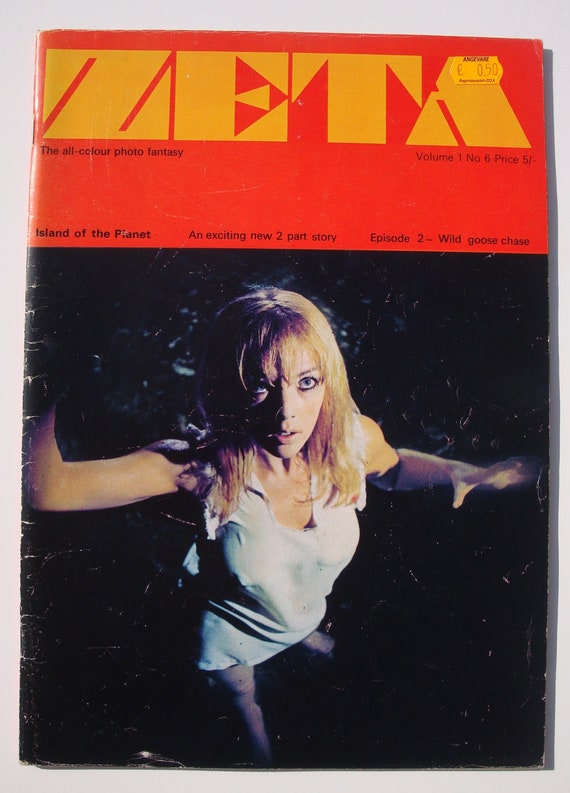
As for sex, that comes into it through his interest in vintage porn, which he claims is all about the period aesthetics rather than any prurient use-value. “You can’t beat a good Mayfair”, Trunk chuckles, before explaining that true connoisseurs hunt for late 1960s periodical Zeta, with its stylish, cutting-edge photography (women in scrapyards). 

ZETA magazine The all-color photo fantasy Vol. 1 No. 6 | Etsy

As with record collector culture, there are fashions on the vintage skin mag scene: “1980s rude mags, that’s the new hot zone -- all DayGlo knickers and shoulder pads.” Trunk put out Flexi Sex (2003), a collection of the ultra-lewd spoken word flexi-singles porn mags once stuck between their soon-to-be-stuck-together pages. Porn informed one of the label’s few non-reissue releases, Dirty Fan Male (2004),  which involved an actor known as Wisbey reading out the filthy fan letters sent to British softcore pornstars, in an assortment of comedic voices. The CD gradually became a cult item, inspiring Trunk to turn it into a stage show, which played at the Edinburgh Fringe Festival in 2004 and won the Guardian’s Best Concept award.

To ‘music, sex, nostalgia’, three other Trunk keywords could be added.

Humour: a good-natured whimsy pervades the whole project.

Britishness: nearly everything on the label was made in the UK and there’s an affectionate fascination for all aspects of this country’s post-War popular culture (the label’s website is packed with Anglo curios  Trunk has stumbled upon, from an album by Stanley Unwin, the comedian who spoke in an invented gobbledygook language, to a record by the show jumper Harvey Smith).

Keyword #3 is “melancholy”: Now We Are Ten teems with softly sad film music by composers like John Cameron and Sven Libaek.

Cheesy sleaze and sepia-toned melancholy seem unlikely bedfellows at first glance. But in his 1935 travel book Journey Without Maps, Graham Greene put his finger on or near the place where musty and lust meet. He wrote about how "seediness has a very deep appeal ... It seems to satisfy, temporarily, the sense of nostalgia for something lost; it seems to represent a stage further back"  

With their aura of wistful reverie and faded decay, the sounds exhumed by Trunk offer a portal into this nation’s cultural unconscious.


see also this very interesting recent chat with Mr Trunk on the story of how he tracked down The Wicker Man soundtrack